Road and driveway crossings
Install products beneath established surfaces while reducing the length of open excavation and reinstatement required.
Horizontal Directional Drilling
Trenchless installation for power, fibre, water, gas, ducts and utility infrastructure across Whanganui and the lower North Island.
The bore is not the whole job
Successful HDD work starts well before the drill head enters the ground.
The proposed alignment, existing services, entry and exit positions, product, tooling, drilling fluid, access and actual ground conditions all affect the result.
We plan the installation as a complete job, then bring the drilling, locating, hydro excavation and support equipment needed to carry it out.
A drilling machine does not automatically make someone a drilling contractor.
Typical applications
HDD is useful where opening the entire route would be expensive, disruptive, impractical or generally unpopular.
Install products beneath established surfaces while reducing the length of open excavation and reinstatement required.
Ducts and product routes for power, fibre and telecommunications infrastructure in urban and civil environments.
Trenchless installation support for underground utility products where alignment, clearances and bore control matter.
Work beneath lawns, footpaths, landscaping and developed areas without turning the full route into an excavation.
Compact set-ups for constrained sites where there is still enough room to complete the job safely and properly.
Staged and larger installations using the drill, tooling and support arrangement suited to the actual scope.
How we approach it
Not revolutionary. Still surprisingly effective.
Product, diameter, route, length, programme, access and what the finished installation actually needs to achieve.
Entry and exit positions, set-up space, traffic, surfaces, existing assets and obvious ways the paper plan may fail.
Trace known services and pothole critical crossings so the bore is based on physical information, not optimism.
Drill, tooling, bore path, reaming stages, fluids, product handling and the support equipment required.
Drill, ream, install the product, deal with changing conditions and leave the job ready for its next stage.
Depth is not a strategy
Sometimes the correct bore is deep. Diving under every known service because holding a controlled profile is harder is not the same thing.
A proper depth comes from the product, required cover, bend radius, entry and exit geometry, ground conditions, clearances, corridor requirements and future access. It is not chosen by pointing the head down until the crossing stops being inconvenient.
Every unnecessary metre below the surface becomes somebody else's excavation later. Tie-ins get deeper. Repairs need more spoil, wider batters or shoring. Maintenance takes longer, costs more and exposes people to a bigger hole.
Road corridors are shared space. The job is to install the asset safely, with the required separation, at a sensible risk-assessed depth that can still be located, connected to and maintained.
A deep bore can be correct. An unnecessarily deep bore is a confession.
Depth is a design decision.
Not an escape route.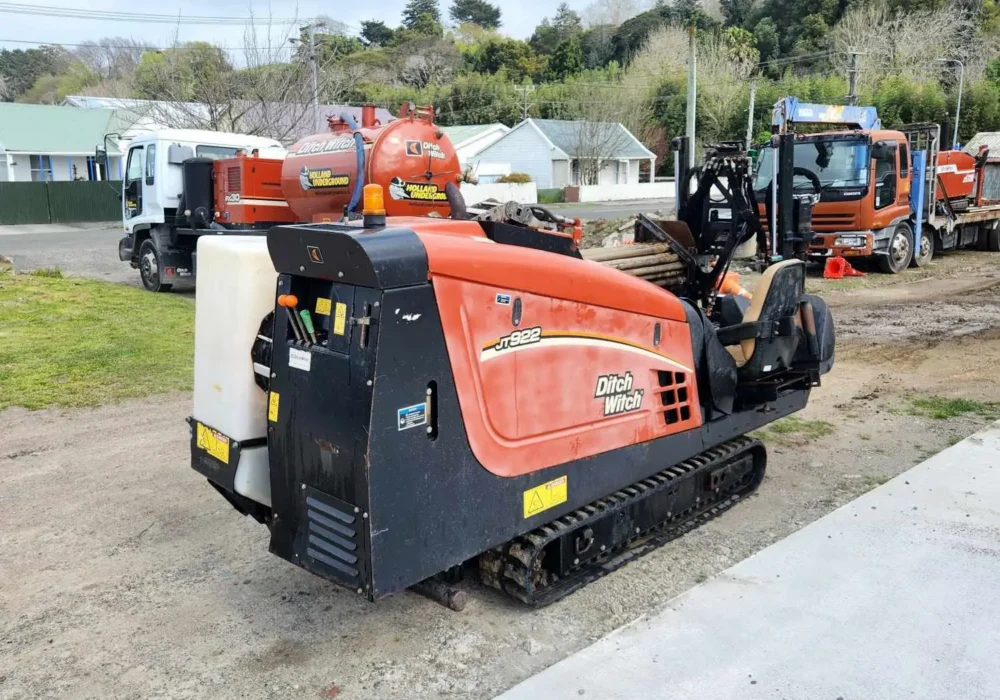
Directional drilling fleet
The fleet gives us options for compact urban work and more demanding installations rather than attempting to make one machine fit every site.
Machine selection depends on product size, bore length, ground, access, alignment and the support equipment needed to finish the work.
See our equipmentWhat helps us price it
You do not need a flawless tender package. You do need enough information for us to understand what is being installed and where the obvious risk sits.
We would rather identify missing information early than price a fantasy.
If the quote assumes the ground, services, access and product will all behave perfectly, it is not a plan.
It is a wish with a dollar sign in front of it.Holland Underground
Send the location, plans, product details and approximate length. We will work through the rest.